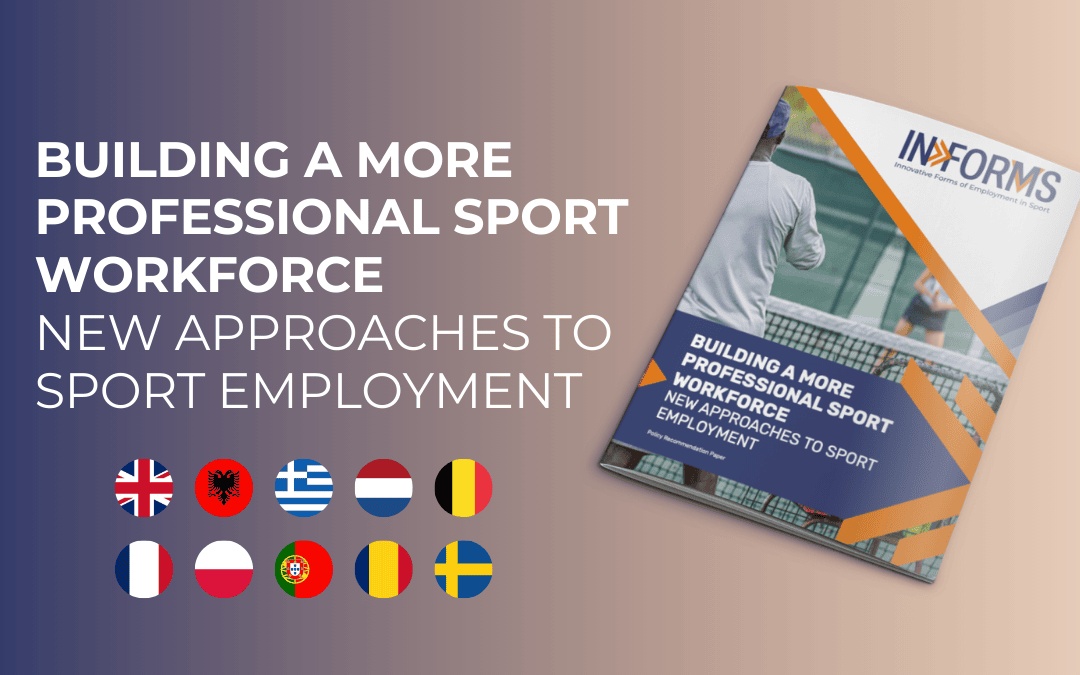
The IN-FORMS partnership has released its Policy Recommendation Paper, Building a More Professional Sport Workforce – New Approaches to Sport Employment, now available in 10 languages.
The paper presents a structured set of evidence-based recommendations to improve recruitment, retention and job quality in the European sport sector, while outlining practical employment approaches that can combine organisational flexibility with greater workforce stability.
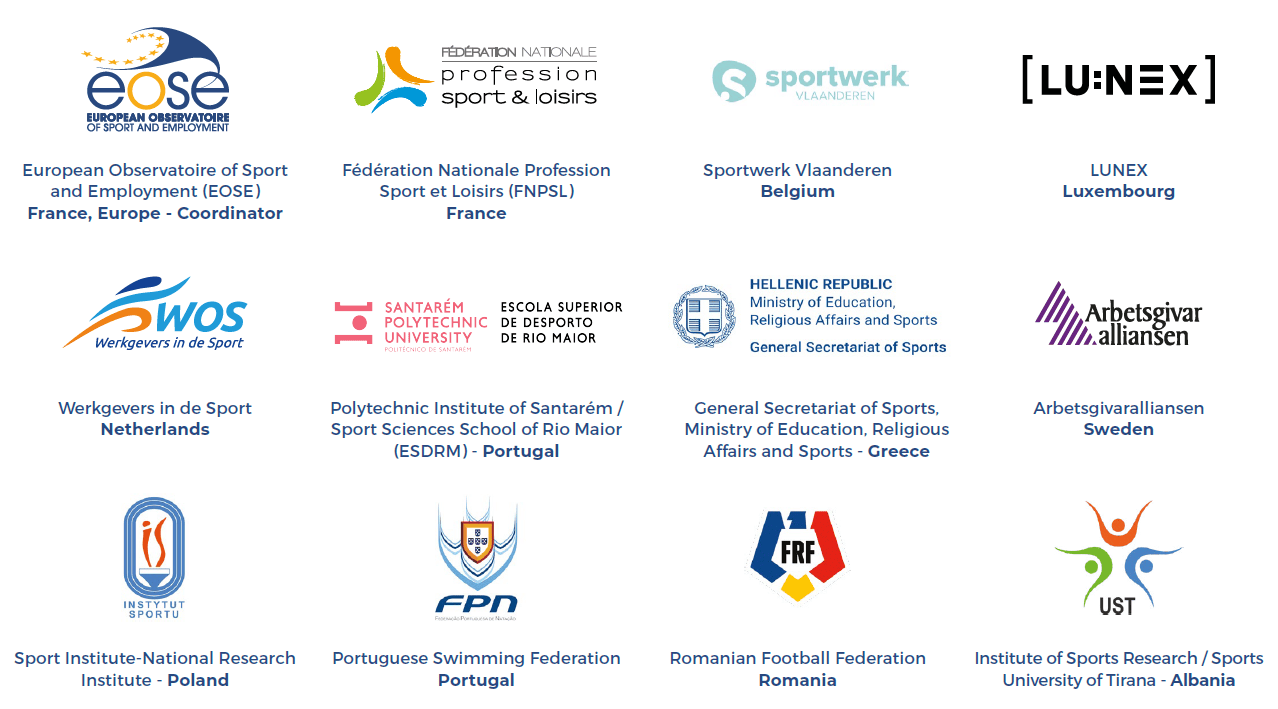
The publication draws on findings from IN-FORMS – an Erasmus+ Sport project involving 12 partners across 10 countries. The evidence base includes desk research, a survey of 2,264 sport organisations, 60 interviews with employers and employees – published in full in a research report – as well as ten national and one international consultation with sport stakeholders.
Why this matters
Sport organisations across Europe are facing structural workforce pressures. The IN-FORMS survey found that:
- 62.6% of respondent organisations attempting to recruit paid staff reported difficulties.
- 85.7% identified retaining skilled staff as a significant challenge.
Eurostat data further show that despite a 32.3% growth in the paid sport workforce between 2011 and 2024 — more than four times the growth rate of the wider EU economy — employment structures remain more precarious than the wider labour market:
- 47.4% of sport and fitness workers in the EU were on part-time contracts in 2024 (vs 18.9% across all sectors).
- 36.4% were in fixed-term employment (vs 13.1%).
- 31% were self-employed (vs 13.1%).
In addition, 29.1% of sport workers were aged 15–24 (vs 8.7% across all sectors), suggesting that while sport attracts young people, it struggles to retain them as long-term professionals.
Survey findings also indicate the persistence of undeclared work in parts of the sector, highlighting risks related to social protection, income security and regulatory compliance.
As a result, the sector faces skills pipeline erosion, retention leakage and fragmented career pathways — outcomes that run counter to EU objectives on decent work, labour market resilience and sustainable competitiveness.
A central structural tension emerges between organisational flexibility — essential in a seasonal and demand-driven sector — and the need for employment stability to retain skilled professionals.
What the paper proposes
The paper advances a two-track approach to professionalisation: strengthening established employment practices while piloting structurally innovative employment models, such as employee sharing, platform work, intermittent permanent employment, and job sharing, which may provide opportunities to address workforce shortages, expand legal employment, and increase flexibility for both employers and employees. Traditional approaches to sport employment – often poorly managed, precarious, part-time, or temporary – are insufficient to support the sector’s evolution to a professional workforce.
1. Strengthening good employment practices
The IN-FORMS research confirms strong sector support for:
- Training and career development
- Improved working conditions
- Creating internships and apprenticeship programmes
- Diversity and inclusion measures
- Improved HR and recruitment processes
- Work–life balance initiatives
Each of these employment practices were seen to have benefits, and policy makers should take them into account and promote them as potential solutions to sport employers with appropriate guidance on their application.
2. Promoting new approaches to sport employment
IN-FORMS identified four approaches that can help sport organisations professionalise while managing seasonal demand and fluctuating workloads typical in the sector:
- Employee sharing (e.g., a federation or an employers’ group employs a pool of coaches on permanent contracts and deploys them to clubs as needed).
- Platform work (e.g., digital matching between qualified instructors and organisations); with explicit caution on safeguarding protections.
- Job sharing (e.g., two part-time people share one job); useful for retention and inclusion, especially for workers with family responsibilities.
- Intermittent permanent employment (permanent contract with irregular yearly hours but a stable monthly salary); suitable for seasonal roles.
Each is analysed in terms of advantages, risks and governance implications. The paper stresses that innovation must be accompanied by legal clarity, social dialogue and worker protection.
Recommendations
The publication provides structured recommendations for:
- EU institutions
- International federations and employer associations
- National and regional ministries
- Federations, municipalities and employer groups
- Trade unions
- Sport organisations
- Education and training providers
Examples for high-level stakeholders include:
- Build better labour market intelligence for sport: ensure reliable data on the sport labour force, and collect supply/demand information.
- Remove “innovation blockers” while protecting workers: work across sport and employment ministries to identify legal obstacles to new employment approaches, and amend frameworks through social dialogue.
- Scale up practical guidance: support dissemination of employment guidance to sport employers
The recommendations will be supported by forthcoming IN-FORMS practical roadmaps for sport employers and employees, a digital tool and an employment expert network (available in 2026).
Download and share
Stakeholders and sport employers are invited to review the recommendations and circulate them within their networks.
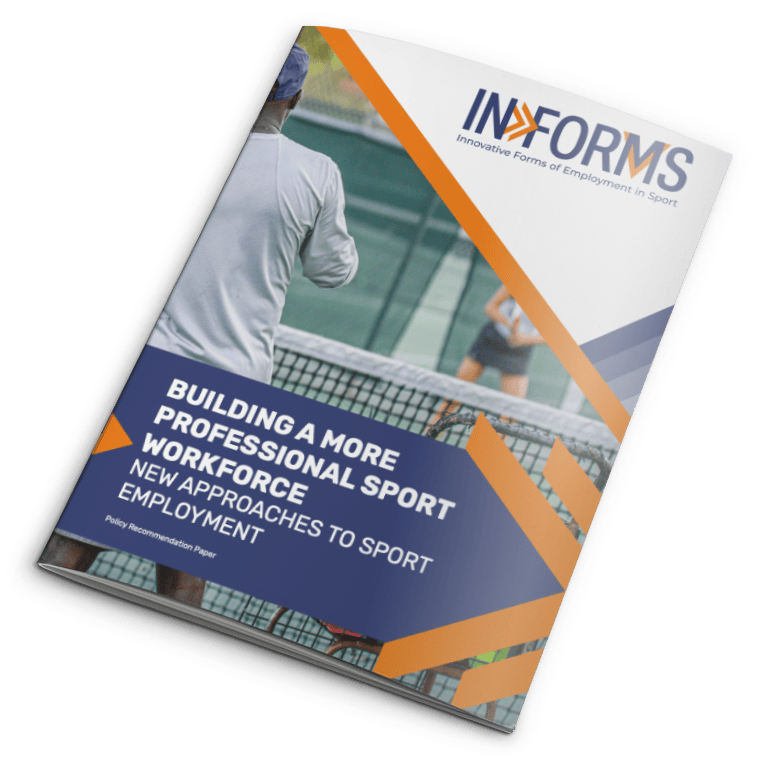
Building a more professional sport workforce: new approaches to sport employment
IN-FORMS Policy Recommendation Paper
Languages: EN | FR | NL-BE | NL-NL | PL | PT | RO | SQ | SV
Published: December 2025
Pages: 29
IN-FORMS Partnership
Contact
Mr Geoff Carroll – EOSE Director of Skills Development – Click here
Mr Wojciech Waśniewski – EOSE Projects & Research Coordinator – Click here
